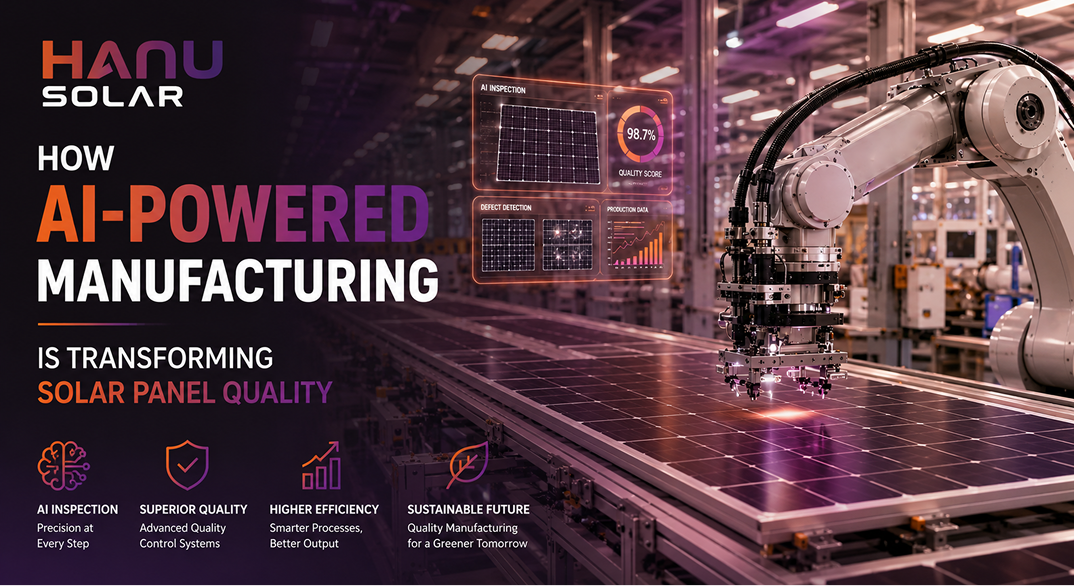
A solar module leaves the factory once and stays on a roof or in a field for thirty years. There is no service visit to fix a hairline cell crack that only shows up under thermal cycling in year four. That single fact is why manufacturing quality control has quietly become the most consequential part of solar production - and why AI-driven inspection is now standard on serious production lines, including our own.
The Limits of Human Inspection
For most of the industry's history, quality control meant a technician looking at a lit panel and checking for visible defects - chips, discoloration, obvious cracks. It worked, up to a point. But the defects that actually shorten a module's working life are rarely visible to the eye. Micro-cracks in a cell, cold solder joints between busbars, and localized hot spots caused by a single underperforming cell all sit below the threshold of human visual inspection, yet they compound over thousands of thermal cycles.
Manual sampling also does not scale. A line producing at gigawatt volume moves cells and strings far faster than a human eye can meaningfully audit every unit, so manufacturers have historically inspected a percentage of output and inferred the rest. That statistical approach is reasonable for cosmetic defects. It is a much riskier bet for the defects that actually drive field failures.
"The defects that shorten a module's working life are rarely the ones a human eye can catch on a moving line. Electroluminescence exposes what visible light cannot.”
— Hanu Solar Manufacturing Engineering
What Electroluminescence Actually Sees
Electroluminescence, or EL, testing works by running a current through a cell in a darkened chamber and photographing the resulting infrared glow. Cells that are structurally sound glow evenly. Cracked, poorly soldered, or electrically disconnected regions appear as dark patches invisible to the naked eye but unmistakable to a camera sensitive to that wavelength.
The step change over the last several years is not the EL camera itself - that technology has existed for decades - it is what happens to the image after it is captured. Instead of a technician manually reviewing thousands of EL images per shift, a trained vision model classifies each cell in real time: crack or no crack, and if a crack exists, whether its size, location, and orientation are likely to propagate under mechanical load and thermal cycling. Cells that fail the threshold are flagged and pulled before they are ever strung into a panel.
100%
Cell-Level EL Coverage vs.
Sampling
<1sec
AI Classification Time Per Cell
1.00%
Typical First-Year egradation Target
Where AI Sits on the Hanu Solar Line
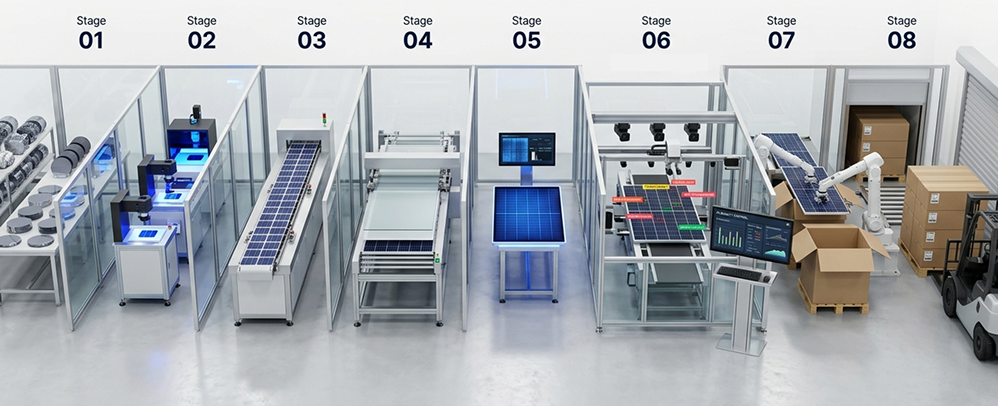
On our production floor, AI inspection is not a single station bolted onto the end of the line - it is threaded through the process, from incoming cell sorting to the final optical scan before packaging.
The Eight-Stage Production Line
Every module is tracked stage to stage - AI inspection is stage six.
At Cell Inspection, incoming N-Type TOPCon cells are sorted by efficiency bin and visual grade before they ever reach the stringer, so a finished module is built from cells with matched electrical characteristics rather than a random mix. At Stringing, laser-guided placement keeps busbar alignment within tight tolerance, which matters because misaligned interconnects are one of the more common sources of the micro-cracks EL testing later catches. By the time a laminated string reaches the AI Inspection stage, the system is combining EL imagery with high-resolution optical scanning to catch surface-level defects - chipped glass edges, frame misalignment, encapsulant bubbling - that electroluminescence alone would miss.
In practice, this means a module is inspected more thoroughly on an automated line today than a technician could reasonably inspect it by hand - at production volumes that would make manual review impossible in the first place.
Why This Matters for the Numbers on the Datasheet
Every specification on a module's datasheet - module efficiency, temperature coefficients, the linear power warranty curve - describes how a module is expected to perform if it is free of the manufacturing defects that cause early degradation. Tighter inspection does not change what a cell is capable of; it changes how consistently a shipped module actually reaches that capability across a full production run, and how reliably it holds that output over the 30-year warranty period rather than degrading faster than the linear warranty curve predicts.
That consistency is also what makes bifacial gain figures meaningful in practice. A module rated for a given bi-faciality factor only delivers that rear-side gain reliably if the front and rear cell strings are free of the connection defects that AI inspection is specifically built to catch. In other words, inspection quality is not a separate topic from module performance - it is the mechanism that makes the datasheet numbers trustworthy in the field, not just in the lab.
The Direction of Travel
As solar manufacturing scales toward multi-gigawatt annual output, the industry does not have the option of solving quality control with more people looking at more panels. The only way inspection keeps pace with production volume is by getting faster and more consistent per unit - which is exactly what AI-assisted EL and optical inspection is built to do. We expect the next iteration of this on our own line to extend further upstream, applying similar classification models to raw wafer and cell inspection before stringing even begins, catching defects earlier in the process where they are cheaper and easier to correct.
The goal has not changed since the first EL camera went into a solar factory: catch what shortens a module's life before it leaves the building. What has changed is how much of that work a production line can now do on its own, at the speed a gigawatt-scale factory actually runs.